

Key takeaways
- I’ve tried to analyse mutual funds using a combination of a range of parameters & data over 20 years. Each time I picked a fund, it would under perform after a few years and I would do some analysis & pick another fund
- I have cycled through 180 actively managed Mutual Funds like this over 20 years
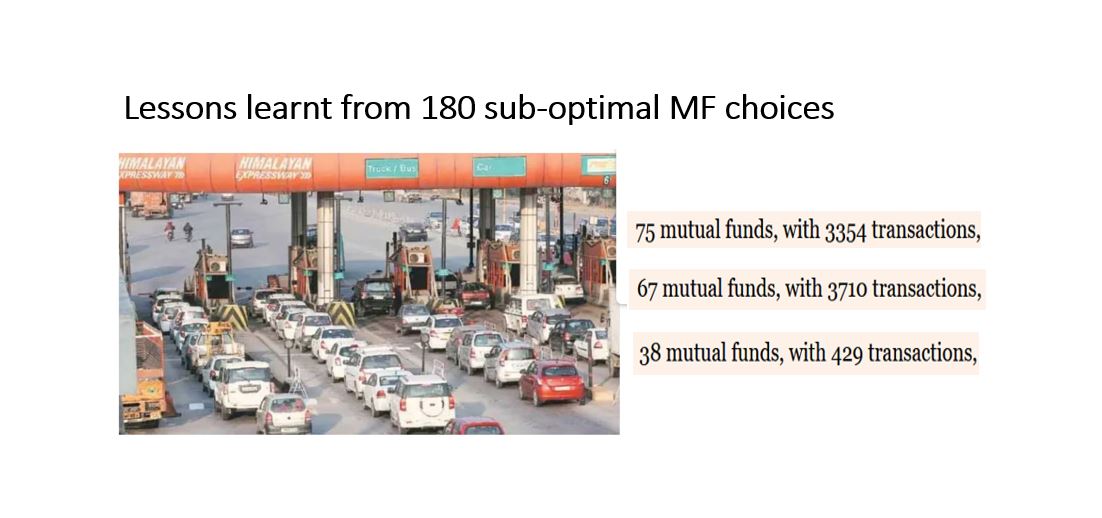
- It’s like when we come to a toll plaza on the highway. We pick the one with the shortest queue. But once we enter that lane, very often we notice that another lane is moving faster and we wish we had taken that other lane.
- Another way to look at it is as follows: when we try to pick mutual funds as individual investors we are competing against other Institutional investors with millions at their disposal, supercomputing power at their finger-tips and armies of sharp financial analysts & programmers who are all trying to pick actively managed mutual funds just like us. So we have very stiff competition indeed.
- We will always see articles in the media that make all sorts of arguments suggesting that active funds can beat the Index. But the astute question we need to ask ourselves is where the funding for these articles comes from. And the reality is that the funding comes from the Mutual Fund companies so it’s most likely a view that is biased in their favour. Plus, they have tens if not 100s of crores in marketing budgets that can easily drown out any views that are not in their own interests.
- I later came across data & research that seemed to suggest that it was nearly impossible to predict which Mutual Fund would do well over the next 10 to 15 years. The legendary John Bogle of Vanguard has validated this many times. Of course this was more than amply validated personally for me by my own 180 Mutual fund selections 🙂
- Buffett stated at his 2004 shareholder meeting that one of the best things a typical investor can do is to invest in a broad market based Index like the S&P 500 – that way he believes one will outperform 90% of other investors
- Buffett is also practicing what he preaches. He has directed the trustees of his own Will to put 90% of his own money after he passes away into just one S&P 500 Index fund
- Buffett also issued a public challenge to any fund manager to beat the S&P 500 over a 10 year period & how he won that bet easily & comfortably.
- In addition, research from the SPIVA India report from S&P suggests that 74% of actively managed large cap & 88% of actively managed Mid/Small cap funds UNDERPERFORM their indices over a 10 year period
Have you ever bought a top performing mutual fund only to find it underperforming after a while and then bought another top performing fund? If you’ve experienced such a situation regularly, you might find my article useful. I have done it approx. 180 times over 20 years. It took me 180 sub-optimal mutual fund choices (the cost of which I am simply unable to calculate) to finally learn a few important lessons. I just hope you will gain something from my article & not have to waste as much time, effort & money as I did to learn these lessons.
Someone asks “Is SBI Contra a good fund?”
Recently on a whatsapp group someone asked if SBI Contra was a good fund to invest in. I looked at the data on Valueresearch & noticed that it had significantly beaten it’s benchmark returns for a reasonably consistent period of time. Looking at the data, it looked like a good fund to invest in.

But as I looked over this performance data, I smiled at myself. It was deja-vu. I can remember myself having done this many many times earlier over a 20 year period – 180 times to be precise. How did I get to this 180 number? Well, when I recently imported me & my family’s portfolio on Valueresearch, these are the snapshots I got.

They add up (coincidentally) to exactly 180 mutual funds that I invested in over 20 years.
It’s interesting to note that I owned SBI Contra around the year 2006 – 2007 when it was a hot performing fund. But then it went out of favour for many years & now almost 20 years later is once again a hot favourite with a 5 star rating.
The typical analysis, choice, invest & exit cycle
The engineer in me can’t resist analysing data when I see it. I definitely get a kick out of it. And so I was always excited to analyse mutual fund data from valueresearch. In the past, each time I would review my Mutual Fund portfolio, I would find some funds underperforming. I would let them underperform for a while being mature & realizing that the fund manager needs to be given time to help the fund recover. But the fund would keep underperforming other funds in it’s category or it’s benchmark index and at some point I would run out of patience. Then I would make up my mind to exit the fund & buy a new one that had either a 5 or 4 star rating and do some analysis on it.
To select the new fund, I would look up multiple data points for the fund in addition to performance, things like standard deviation, fund manager tenure etc etc. then create multiple columns in a spreadsheet to put various key parameters of each possible new fund into one place. Then I’d review the data & make a selection based on a combination of criteria.
One or two years later, while reviewing the performance of my mutual funds, I would again find a few funds that were performing very well at the time I selected them but were underperforming now. And then the whole cycle above would repeat again & again. And that’s how I ran through 180 mutual funds in about 20 years.
Picking Mutual funds: Like switching lanes at a toll plaza
As I reflect back on it, the analogy that comes to mind is of what many of us experience while driving on the highway in India. We come to a toll booth. There are at least 4 to 5 lanes if not more. We pick the one with the shortest queue. But once we enter that lane, we notice that another lane is moving faster and we wish we had taken that other lane.

My story with picking actively managed funds was very similar to that of picking a lane at a toll plaza & finding that other lanes are moving faster. Every time I picked an active mutual fund, after a couple of years, I found that some other funds were doing better & felt tempted to move to the other fund.
As I now realise, not only is such fund switching time consuming but it is also counterproductive performance wise because each time I switched funds, I paid taxes.
See the data below from valueresearch that shows that average investor returns in SIPs in mutual fund categories were 1% to 3% lower than the actual performance of those categories. All of this because most investors like myself simply cannot sit still & hold on to a mutual fund as it starts under-performing.

Why we can’t analyse & pick mutual funds: Competition from Institutional investors
Institutional Investors from across the globe including the Government of Singapore, Pension Funds in Norway & the like who have millions of dollars at their disposal, supercomputing power at their finger tips and armies of sharp financial analysts & programmers are all trying to pick actively managed mutual funds all the time. The same holds true for Domestic Institutional Investors such as Banks & Insurance companies in India. So this is your REAL competition as a simple retail investor.
Given this insight, when I think back at how I used to create a spreadsheet with a few columns & try to analyse mutual funds, (and even thought I was being quite intelligent & analytical in my fund selection process) I can’t help but laugh at myself & wonder “What on earth was I thinking?”.
My first exposure to & struggle with Index fund investing
I first read about Index funds in a book called the “The Lazy Person’s Guide to Investing” around the year 2010. Reading the book, I felt quite convinced about the concept and even went ahead & bought a fund from Benchmark Mutual Fund that had released a BSE 500 Index fund.
But then I kept reading articles that constantly had all sorts of theoretical arguments against Index investing. Arguments that ranged from those that suggested the weighting of the Indices in India were not proper to others that suggested that the Indexing theory simply did not apply to India because the Indian markets were a different beast and many more. So I got swayed by those articles & stuck to actively managed funds for a number of years more.
They say that if you want to get to the truth of a matter, one sure fire way is to “follow the money” i.e. look at who is paying for a particular point of view to be written. Then suddenly I had what one calls an “aha” moment & it hit me ! Of course most of the articles I was reading were paid for by Mutual Fund AMCs and the AMCs earn a lot more when they sell active funds due to higher fees / expense ratios – no wonder the rhetoric was all about active funds being better ! In addition, AMCs have budgets in crores to market their funds & their point of view that active funds are better. Lastly, Mutual Fund distributors & Financial advisors get to earn higher commissions if they sell actively managed funds.
So the odds are very heavily stacked against an individual trying to go against this huge tide of marketing & sales pitches for one to buy active funds.
In addition, at any given point in time, there are a number of funds that actually have beaten the Index for 3, 5 or maybe even 7 years. So that data is undeniable & I often felt very tempted to stick with one of those funds that I owned thinking “maybe, just maybe, THIS one is an exception & it’ll keep out performing”. But each time I remind myself that although funds have & will continue to outperform their indices, that’s only in hindsight. We can only look back AFTER the outperformance & point to a fund as a star performer. We simply cannot predict it years in advance.
What made me finally switch to Index funds
But the more I saw myself switch funds again & again & again, the more I had to accept that I simply did not know how to pick a fund that would do well over the next 5 to 10 years. And the stuff I’d read in a book in 2010 kept ringing true & coming back to haunt me.
Later, I found solace as I started reading about lots of research that seemed to suggest that it was nearly impossible to predict which Mutual Fund would do well over the next 10 to 15 years. Here is an article in the Economic times that has lots of data that supports the fact that past performance is no predictor of future performance.
I found further solace as I read Warren Buffett’s repeated advice (below) to retail investors like you & me that seemed to suggest the solution to the problem of not being able to pick the best fund in the future: The advice was simply to invest in a broad based (i.e. cross sector) market cap weighted Index fund.
Buffett’s advice on Index funds at his 2004 annual shareholder meeting
I came across content by Warren Buffett suggesting that the best thing a typical investor could do was to invest in Index funds. To quote, here’s what Buffett said at the 2004 Berkshire Hathaway annual meeting. “If you invested in a very low-cost index fund — where you don’t put the money in at one time, but average in over 10 years — you’ll do better than 90% of people who start investing at the same time,” Here’s a link to the video of him saying these words at his 2004 annual Berkshire shareholder meeting: https://buffett.cnbc.com/video/2004/05/01/berkshire-stock-vs-index-fund.html

Then I read an article that said Buffett was practicing what he was preaching – that Buffett had directed the trustees of his own Will to put 90% into just one S&P 500 Index fund.

Buffett’s bet on Index funds Vs a Hedge Fund
But that’s not all. In 2007 Buffett put out a challenge for hedge fund managers to beat the S&P 500 Index fund over a ten year period. Hedge fund firm Protégé Partners came forward and put a million dollars on the line in 2007. Buffett won the bet and by quite a margin as you can see in the chart below.

I then heard about the SPIVA report (S&P Index vs Active) that diligently tracks what percentage of active funds beat the Index in each category. The latest SPIVA report for India seems to suggest that 74% of actively managed large cap & 88% of actively managed Mid/Small cap funds UNDERPERFORM their indices over a 10 year period !

And that is when I finally made the switch to Index funds. Precisely after having cycled through 180 mutual funds & seen all of Buffett’s tremendous conviction around how powerful investing in Index funds is.
It took me 180 sub-optimal mutual fund choices (the cost of which I am simply unable to calculate) to finally arrive at the wisdom of investing in Index funds. I just hope you will not have to waste as much time, effort & money as I did to learn the lesson.
Disclaimer: I am not a financial advisor. My articles are meant for people who are not savvy or well versed with personal finance and investing and find it difficult to grasp all the jargon typically used when discussing such topics. I hope to be able to demystify investing and make it as simple as possible for everyone. I’ve invested in Mutual funds for approx. 24 years. I’ve also been a diligent student of the subject of investing over the past 24 years learning & applying the writings of luminaries in the field. In these articles I’m merely sharing my experience & learning from that investing journey and the books of luminaries in the field in the hope that it might help others in some way. I am in no way directly or indirectly claiming to be a hot shot investor who has generated exceptional or even above average returns during my investment journey. However, I am quite confident that even if all you do is learn from my mistakes, educate yourself on sound investment principles & develop good financial habits you will benefit greatly. Please ensure that you consult a financial advisor before taking any decisions or actions concerning your personal finances or investments. I shall not be liabl