

Key takeaways
- This strategy is arguably one of the best kept investing secrets in my view
- What you do during market downturns determines the bulk of your net worth
- Many investors tend to stop their SIPs or worse, start selling equity during a downturn while the opposite is needed for success
- In this article I lay out a SIP like strategy with automatic re-balancing which enables you to take advantage of market downturns
- Most investors are unaware of the significant gains to be had potentially from the above strategy
- Most investors also do not know how to re-balance while doing an SIP
- This strategy, called “Value Averaging” was developed by Michael Edleson
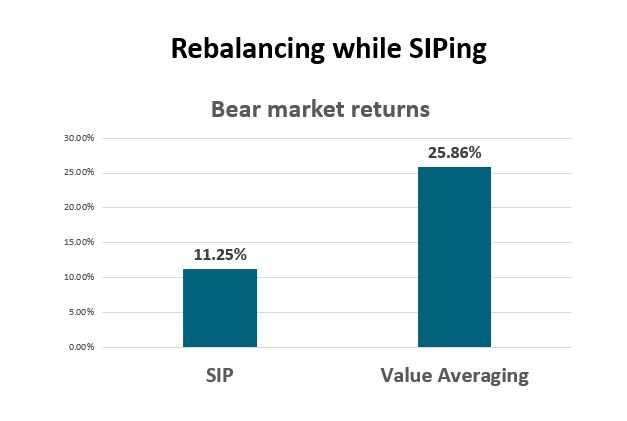
- Michael’s research showed that at the extreme, in a beaten down “bear” market SIP yielded 11.25% while Value averaging: yielded 25.86%
- Value averaging forces you to buy more than an SIP at market lows
- Value averaging by design prevents you from panic selling in a bear market
- As a result of all the above, Value Averaging, usually (but not always) provides higher returns than an SIP i.e. across bull & bear market cycles combined
- This strategy, once setup, AUTOMATICALLY & by design takes care of helping you decide EXACTLY how much more to invest during a market downturn
- You also don’t have to worry about tracking PE or any other valuation metrics
Most investors know that portfolio re-balancing is a best practise yet few have probably done it. Why? Two reasons:
1. We are unaware of how much one can potentially gain by doing this and
2. Most of us are doing SIPs & no one ever told us HOW to rebalance while doing an SIP.
The name of the investment strategy that is something of a hybrid or combination of an SIP with automatic re-balancing as one goes along is called Value Averaging.
Value averaging is a strategy worth considering because it provides significant gains in a bear market. As per Michael Edleson who came up with this strategy, “… at the extreme, in a beaten down “bear” market SIP yielded 11.25% while Value averaging: yielded 25.86%”
Who is Michael E Edleson?
Michael came up with / founded the value averaging approach. He is a Managing Director of Morgan Stanley and oversees the firm’s equity risk globally. Prior to that, he was Chief Economist of NASDAQ and a finance professor at Harvard Business School. Edleson earned his PhD at MIT.
What is value averaging?

In very simple terms one could think of Value Averaging as an alternate approach to doing an SIP with simultaneous & automatic rebalancing as you go along. Just like an SIP you invest amounts gradually over a long period of time.
Unlike an SIP, however, it involves both buying and selling. It forces you to buy more than SIP when markets are low and suggests a possible sale of units when the markets are high.
The concept of value averaging explained
Here you focus on the CURRENT MARKET VALUE (unlike SIP you don’t focus on how much you are putting in) of your equity investments and ensure that the current market VALUE of your investments increase by a set amount every month. This is called the process of creating what’s called a “Value Path”. (see column titled “Planned Value” in the table below)
Then every month, you compare the value in the column below titled “Current actual value” vs the amount in the column “Planned value” – if the current value is lower than planned value you buy enough to bring it up to the planned value, else you do the reverse.
For example, in Feb the actual value is Rs 200 below the planned value so you buy units worth Rs. 200.

Benefits of value averaging vs SIP
In short, here are a few reasons why Value averaging works better than a standard systematic investment plan method.
- Forces you to buy more than an SIP at market lows
- Results in a lower average purchase price per unit than an SIP
- By design it prevents you from panic selling in a bear market
- As a result of all the above, usually (but not always) provides higher returns than an SIP
Apart from the significant potential gains that can accrue to anyone using this strategy, once setup, AUTOMATICALLY & by design takes care of helping you decide EXACTLY how much more to invest during a market correction, crash or downturn. You don’t have to worry about tracking PE or any other valuation metrics neither due you have to calculate the extent of the fall etc.
If interested, here is an article of mine where I explain in detail how to actually implement value averaging using a spreadsheet
If you would like me to email you Michael’s spreadsheet, message me & I’ll send it across. If you would like help implementing the value averaging strategy for your investments, reach out & I’ll be happy to help.
Disclaimer: I am not a financial advisor. My articles are meant for people who are not savvy or well versed with personal finance and investing and find it difficult to grasp all the jargon typically used when discussing such topics. I hope to be able to demystify investing and make it as simple as possible for everyone. I’ve invested in Mutual funds for approx. 24 years. I’ve also been a diligent student of the subject of investing over the past 24 years learning & applying the writings of luminaries in the field. In these articles I’m merely sharing my experience & learning from that investing journey and the books of luminaries in the field in the hope that it might help others in some way. I am in no way directly or indirectly claiming to be a hot shot investor who has generated exceptional or even above average returns during my investment journey. However, I am quite confident that even if all you do is learn from my mistakes, educate yourself on sound investment principles & develop good financial habits you will benefit greatly. Please ensure that you consult a financial advisor before taking any decisions or actions concerning your personal finances or investments. I shall not be liable.