

Key takeaways
- A bias for action works well for most areas in life. Not so for investing
- Successful investing requires one to resist the urge to “do something” – particularly in bear markets
- Munger said you should never interrupt compounding
- Bernstein says the bulk of your net worth is determined by what you do during the worst times
- In most cases investors will be better off doing nothing other than a few tried & tested best practices
- Mistake 1: Investors stop SIPs and / or start selling
- Data from valueresearch shows that the investor who continued his SIP did best
- Mistake 2: Investors start to tinker around with their originally decided portfolio asset allocation i.e. adding to a recent top performer or reducing from a recent laggard
- Research from Morningstar shows that portfolio tinkering does more harm than good
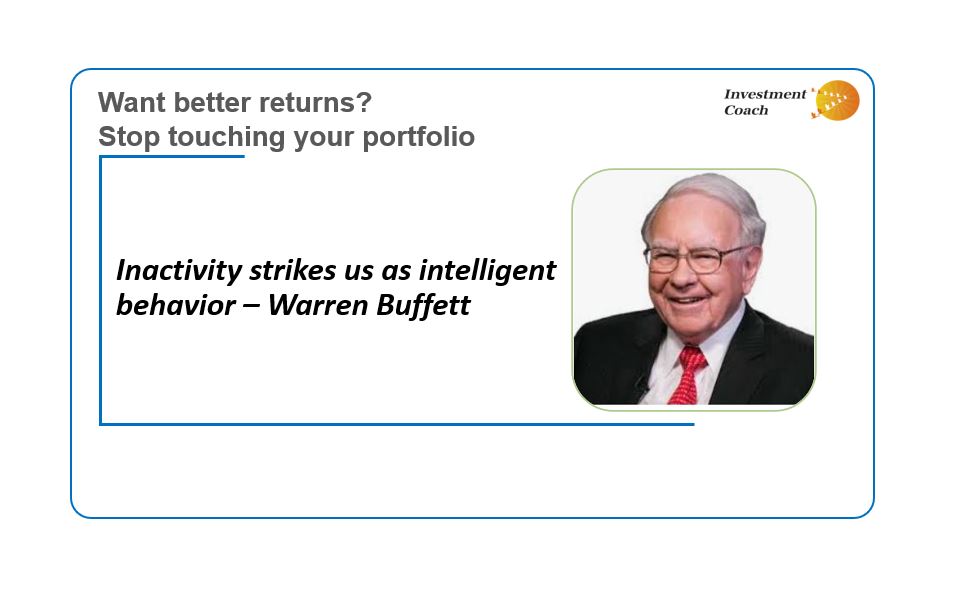
- Multiple quotes from Buffett suggest the typical retail investor should do nothing
- A fidelity study found that investors who were dead or left their portfolios untouched consistently outperformed those that traded frequently
- Berkeley professor Terry Odean did a study where he found that women outperformed men by 1% because they traded 45% less than men
- I’ve personally observed family members who followed the “do nothing” approach do very well
- Best practise 1: Shut out doom & gloom content
- Best practise 2: Don’t look at portfolio more than once or twice / year
- Best practise 3: Continue SIP
- Best practise 4: Re-balance per original asset allocation
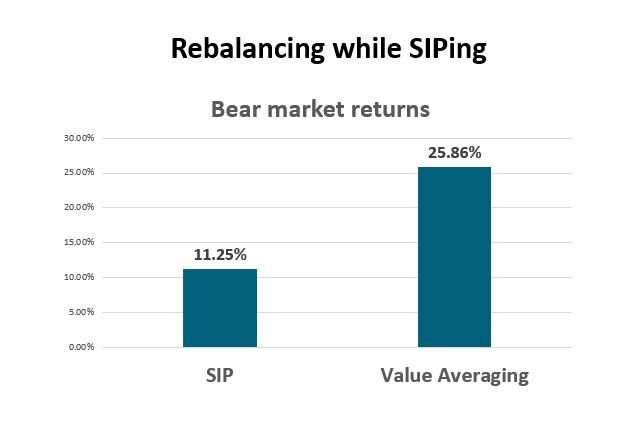
- Best practise 5: Re-balance while SIPing
- Best practise 6: Dynamic asset allocation
Most investors and high achievers come with a bias for “action” in their DNA and it is this penchant for action that has brought them success in life. This is, without a doubt, a very valuable trait in most areas in life but with investing it’s not necessarily a good thing.
Most people feel the need to just “do something” when the markets are super high as well as when they are down in the dumps. The reality is that to be successful at investing long term, one needs to learn to control or resist this urge to “do something” all the time with one’s investments. On the contrary, however, they say that successful investing should be like watching paint dry.
Bulk of net worth determined by response in worst times
Charlie Munger said that “The first rule of compounding is to never interrupt it unnecessarily.”
And Dr. William Bernstein builds on that and says that as a consequence: “The bulk of your net worth derives from how well you behave during the worst 2% of the time”
It follows therefore that what you do during market crashes, corrections or during long stagnant markets is a great determinant of your net worth over the long term. And most often, in bear markets like the one we are in currently in India, people tend to take actions that interrupt compounding & thereby normally end up doing more damage than good to their portfolios. In most cases, in such a bear market, investors will be better off just standing still & doing nothing i.e. doing nothing different from what they were doing earlier.
Mistake 1: The mistake of stopping SIPs or selling

Typically, during such periods many investors tend to get discouraged. And when they get discouraged, they tend to either stop investing in the equity markets or worse they start selling their equity holdings. Let’s look at the recent market downturn for example. In March 2026, 53 lakh SIPs were stopped. Such actions interrupt compounding & lead to lack lustre returns finally.
Here’s a study from Valueresearch that shows how investors with various responses performed through the 2008 crash (starting 2005 & ending in 2025). Look at the infographic with data below.
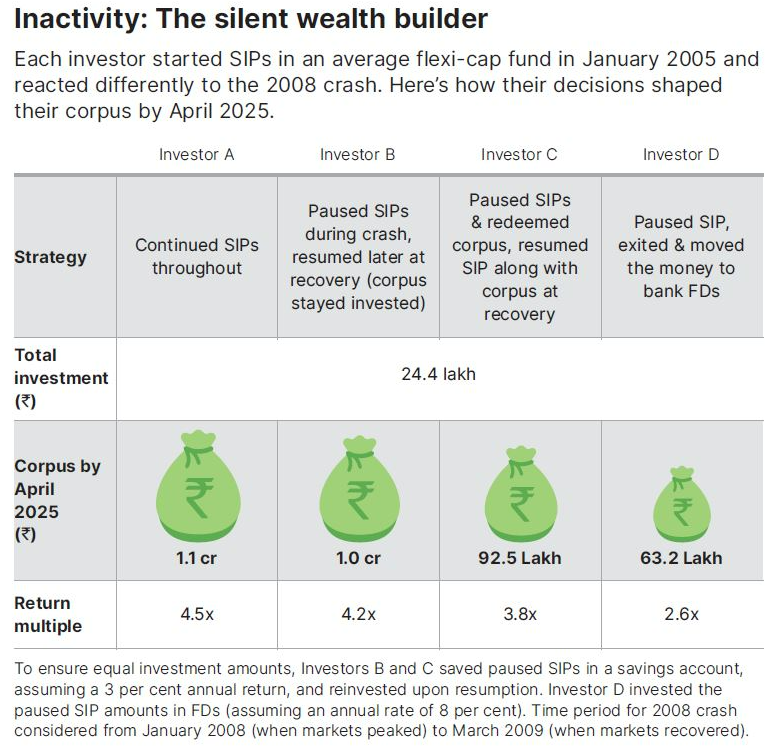
As you can see clearly, the investors that simply continued their SIPs through the bad times came out ahead.
Mistake 2: Adding / switching across investments
I’d hazzard a guess that most of us know better than to stop our SIPs or sell during a market downturn. However. even if people don’t panic & sell, which is by far the worst response during a market downturn, people tend to get tempted into making changes to their portfolio. For example, recently when Gold started rocketing upwards everyone flocked to Gold, Right now, given that the Indian market has been flat for almost 2 years, everyone is looking to the US or other International markets as greener pastures. However, such actions or behaviours typically just don’t work.
Here’s a short extract from Morningstar’s research on adding or switching asset classes:
“Over the years, Morningstar has measured the future performance of fund categories, and compared that with current sales/redemption activities. Regrettably, the best-selling categories tend to underperform in future years. And the categories that suffer the most redemptions often rebound”
Just as one example, below is a chart from Valueresearch that shows how the leading asset class changes every few years. The last column on the right shows the leading asset class over a 45 year period.
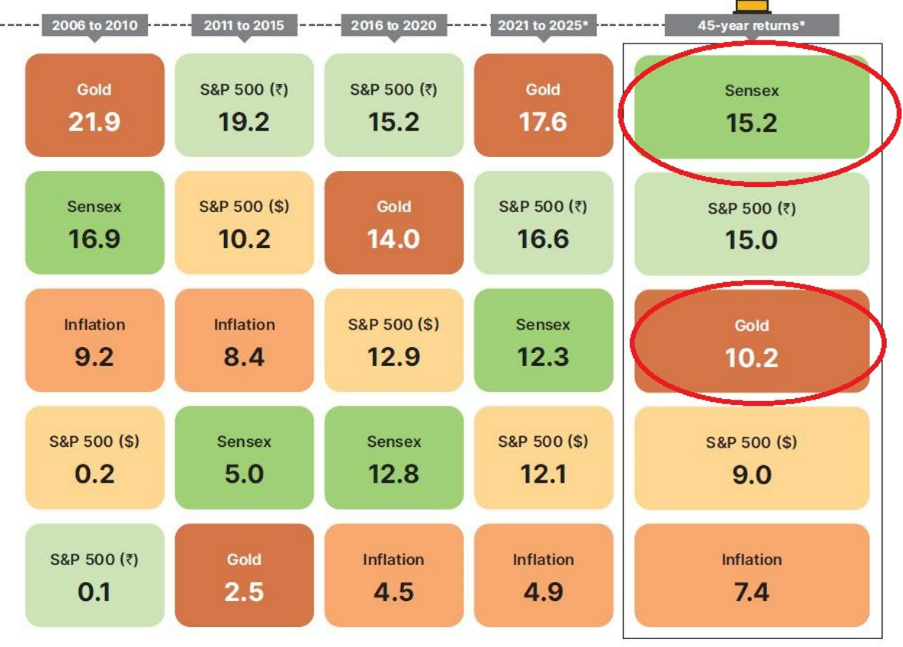
There are dozens of such year wise leaderboard charts all over the internet for sectors, factors, market caps & countries. There are no patterns in these charts. This demonstrates that there is no way to predict the investment that will win over the next decade.
Less action better: Warren Buffett’s views
In most areas of life, taking action is usually a good thing. It is not necessarily so in investing as is borne out by Buffett’s quotes below. Here are another couple of quotes from Buffett in line with this advice:
“Our portfolio shows little change: We continue to make more money when snoring than when active”
“Lethargy, bordering on sloth, remains the cornerstone of our investment style.”
“Doing nothing” is a very simple (but not easy) yet very powerful response to market downturns. This is because, at the very least, it prevents you from doing something out of fear, worry, anxiety or haste which will inflict damage your investments.
Fidelity study: Dead investors performed better
In a study Fidelity examined thousands of brokerage accounts and found that investors who left their portfolios untouched, either because they had died or lost track of their accounts, consistently outperformed those who traded frequently.
You can read more on that Fidelity study at this article on Moneycontrol
Women trade less, do better
When Berkeley professor Terry Odean did a study one of his side discoveries was that women fared better than men. Again, the reason was due to trading volume. The average woman in the broker’s database outgained the average man by 1%per year. That’s because the women traded 45% less often than did the men.
A personally observed story
Let me illustrate with a story. I know a family member who had a share portfolio of about 30 stocks worth approx. 30 lakhs in 2004. This was a portfolio of good blue-chip stocks that had been invested in the decades preceding 2004. This person has just kept these stocks in his demat account and literally did NOTHING with them for the past 22 years.
The market has done all sorts of gyrations in these past 22 years. Despite all these gyrations this person’s stock portfolio has today grown to approximately 3 crores i.e. well over 10 times it’s original value.
I’ve read similar stories of investors who literally “forgot” about hard copy shares they had while they lay in a cupboard for decades and found them after decades. These investors who literally forgot about the existence of their shares did far better than their active “do something” investor friends.
I’ve also read about other research that says that some of the most successful investors do less than 2 transactions per year.
“Do nothing” is easier said than done. I realise that doing absolutely nothing can be hard. It’s true for me so I can empathise. So if you feel an irresistible urge to just do “something” during a market downturn, here are a few relatively safe things you can do without inflicting damage on your portfolio.
So what then can we “DO” during a market downturn?
We all know that we shouldn’t panic & sell during a market downturn. But one reason that happens is because of all the negative content that starts floating on the internet during times of gloom & doom.
Action 1:
So one of the best things you can do for yourself is to intentionally close your eyes & ears to content on the internet about the markets, economy & other negative doom & gloom news in general. The less you consume such content, the less likely you will be to feel tempted to take some action – most likely sell.
Action 2:
The second best thing you can do is not to look at your portfolio & it’s returns. Research has shown that the best investors rarely look at their portfolios – perhaps once or maybe twice a year at the maximum.

Action 3:
If you are investing via an SIP, simply continue your SIP as usual & get busy doing other important things in life.
Action 4:
Another worthwhile thing to do is to re-balance your portfolio as per certain well defined triggers.

Action 5:
Alternately, follow a strategy that combines both SIP as well as re-balancing
Action 6:
Lastly, one could employ a strategy called Dynamic asset allocation as per Dr. Bernstein’s guidelines.
In summary, nothing should be done reactively or as a knee jerk reaction to a bear market, correction or a crash and based on recent (3 to 5 years) performance of any investment type. A clear investment blueprint / plan (including most importantly an asset allocation) should have been put in place calmly and based on well worn & time-tested strategies & principles. Whatever is done during a bear market should be done in line with that original plan & the above 6 best practices.
Disclaimer: I am not a financial advisor. My articles are meant for people who are not savvy or well versed with personal finance and investing and find it difficult to grasp all the jargon typically used when discussing such topics. I hope to be able to demystify investing and make it as simple as possible for everyone. I’ve invested in Mutual funds for approx. 24 years. I’ve also been a diligent student of the subject of investing over the past 24 years learning & applying the writings of luminaries in the field. In these articles I’m merely sharing my experience & learning from that investing journey and the books of luminaries in the field in the hope that it might help others in some way. I am in no way directly or indirectly claiming to be a hot shot investor who has generated exceptional or even above average returns during my investment journey. However, I am quite confident that even if all you do is learn from my mistakes, educate yourself on sound investment principles & develop good financial habits you will benefit greatly. Please ensure that you consult a financial advisor before taking any decisions or actions concerning your personal finances or investments. I shall not be liable.